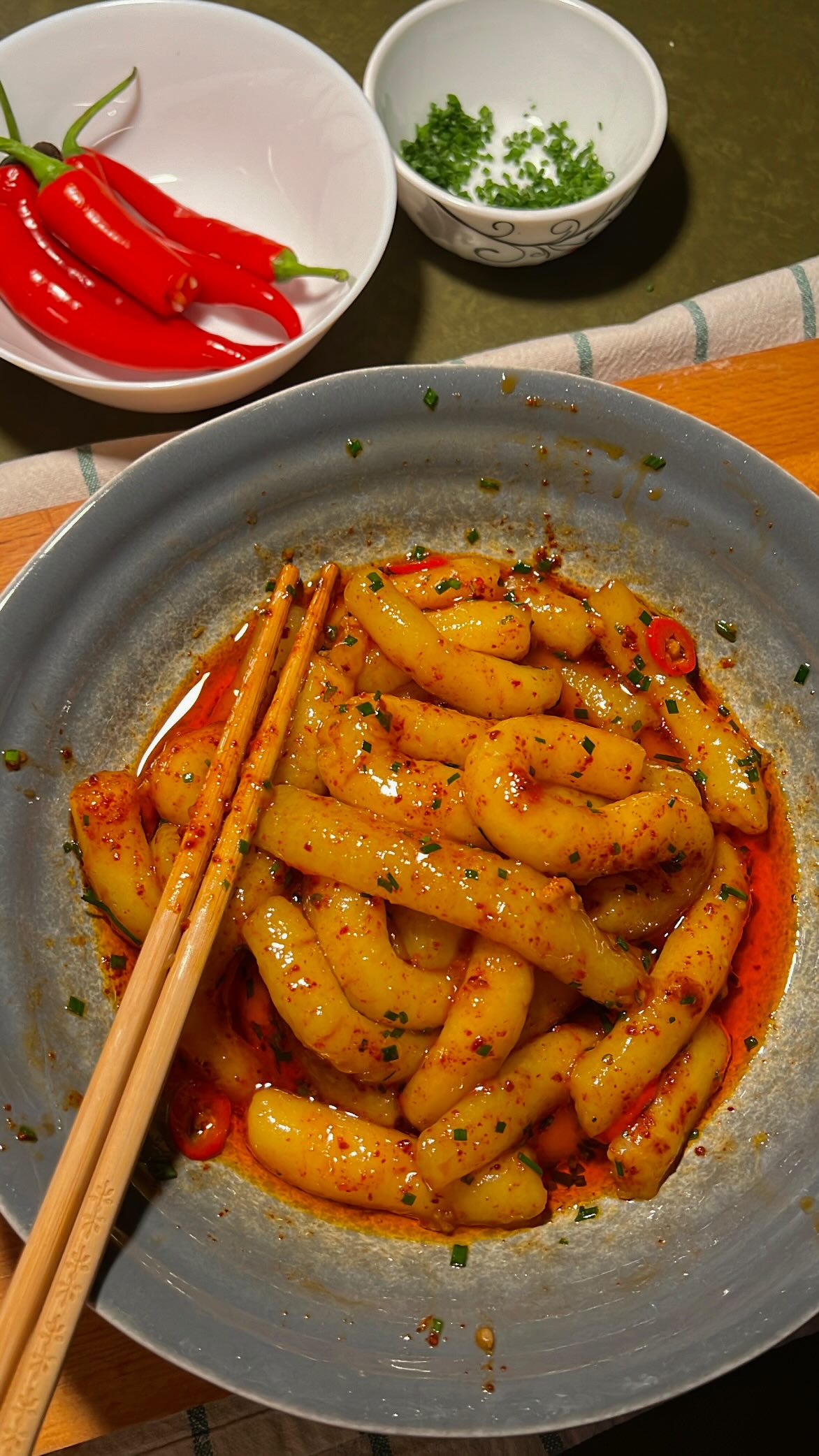
Pure potato starch forms chewy noodles only when mixed with boiling water first—this 100°C shock gelatinizes starch instantly, no wheat required.
Potato Noodles
Get ready to fall in love with these delightful Potato Noodles! Made from tender, starchy potatoes and a hint of garlic, these chewy noodles are the perfect canvas for your favorite sauces. With a quick boil and a toss in some olive oil, you'll have a dish that's both comforting and oh-so-satisfying!
Prep
15
min
Cook
30
min
Serves
4
people
Level
beginner
The Story
This chewy spud-noodle trick traces back to Yanbian, the Korean-Chinese border region of 1950s Jilin Province, where ethnic Korean farmers had potatoes but no wheat fields, so they ground tubers into starch and borrowed China's hot-oil-sizzle technique—resulting in a noodle that's neither fully Korean nor Chinese but something Genghis Khan's horsemen never imagined eating with gochugaru.
Regional Twist
Up in Yanbian itself, cooks swap the gochugaru for doubled fresh chili and stir in fermented soybean paste alongside the soy sauce, giving the potato starch noodles a funkier, muddier punch than Seoul's cleaner, sweeter version ever musters.
📝 Ingredients
Serves 4🥬Fresh Produce(3)
- 2 cloves garlic, minced
- 2 russet potatoes, peeled and boiled
- 1 cup potato starch (240 ml)
🫙Pantry Staples(1)
- 2-3 tbsp hot oil (or more) (30-45 ml)
🧂Spices & Seasonings(1)
- Salt, to taste
🍯Sauces & Condiments(1)
- 1 tbsp soy sauce (15 ml)
📦Other(3)
- Fresh chili, sliced
- 1 tbsp chives, chopped (15 ml)
- 1 tbsp gochugaru (15 ml)
Nutrition (per serving)
Calories
315
Protein
13g
Carbs
57g
Fat
9g
👨🍳 Instructions
- 1
Peel and boil the potatoes until fork-tender. Drain well and mash until completely smooth.
- 2
Add the potato starch and salt. Knead until a smooth dough forms. If the dough feels too dry, add a little water.
- 3
Divide the dough into a few pieces and roll each piece into long noodle shapes.
- 4
Bring a pot of water to a boil and cook the noodles for 2-3 minutes, or until they float to the surface.
- 5
Transfer the noodles to cold water, then drain.
- 6
Place the noodles in a bowl and top with the garlic, chives, fresh chili, and gochugaru.
- 7
Pour the hot oil over the aromatics to sizzle them.
- 8
Add the soy sauce and mix everything well.
- 9
Enjoy while warm!
💡 Pro Tips
- ✓Boil potatoes to 208-212°F (98-100°C) until completely fork-tender, then mash immediately while still hot to break down cell walls and create a uniform paste with minimal gluten development—cold potatoes require 30% more kneading and risk overdeveloping starch networks.timing208-212°F | immediately after cooking
- ✓Maintain a 2:1 potato-to-starch ratio by weight (approximately 200g mashed potato to 100g starch) because excess starch creates brittle noodles that snap during cooking, while too little starch prevents the dough from holding its shape due to insufficient gelatinization.ingredient2:1 ratio | potato:starch by weight
- ✓Cook noodles at a rolling boil (212°F) for exactly 2-3 minutes and remove immediately after floating to prevent starch gelatinization from exceeding 85%, which causes the noodles to lose elasticity and become mushy within 30 seconds of overcooking.timing2-3 minutes | 85% gelatinization threshold
- ✓Heat your oil to 350-375°F (175-190°C) before pouring over garlic and gochugaru because this temperature rapidly evaporates moisture around aromatics and triggers the Maillard reaction, creating depth without burning spices (which occurs above 400°F).technique350-375°F | prevents scorching above 400°F
- ✓Ice-bathe the cooked noodles for 30-45 seconds to stop gelatinization and set the starch structure, preventing them from fusing together when drained—longer than 60 seconds causes them to absorb excess water and become gummy.timing30-45 seconds
Share this recipe
Prep
15
min
Cook
30
min
Serves
4
people
Level
beginner
Share this recipe
Pure potato starch forms chewy noodles only when mixed with boiling water first—this 100°C shock gelatinizes starch instantly, no wheat required.
Potato Noodles
Get ready to fall in love with these delightful Potato Noodles! Made from tender, starchy potatoes and a hint of garlic, these chewy noodles are the perfect canvas for your favorite sauces. With a quick boil and a toss in some olive oil, you'll have a dish that's both comforting and oh-so-satisfying!
The Story
This chewy spud-noodle trick traces back to Yanbian, the Korean-Chinese border region of 1950s Jilin Province, where ethnic Korean farmers had potatoes but no wheat fields, so they ground tubers into starch and borrowed China's hot-oil-sizzle technique—resulting in a noodle that's neither fully Korean nor Chinese but something Genghis Khan's horsemen never imagined eating with gochugaru.
Regional Twist
Up in Yanbian itself, cooks swap the gochugaru for doubled fresh chili and stir in fermented soybean paste alongside the soy sauce, giving the potato starch noodles a funkier, muddier punch than Seoul's cleaner, sweeter version ever musters.
📝 Ingredients
Serves 4🥬Fresh Produce(3)
- 2 cloves garlic, minced
- 2 russet potatoes, peeled and boiled
- 1 cup potato starch (240 ml)
🫙Pantry Staples(1)
- 2-3 tbsp hot oil (or more) (30-45 ml)
🧂Spices & Seasonings(1)
- Salt, to taste
🍯Sauces & Condiments(1)
- 1 tbsp soy sauce (15 ml)
📦Other(3)
- Fresh chili, sliced
- 1 tbsp chives, chopped (15 ml)
- 1 tbsp gochugaru (15 ml)
Nutrition (per serving)
Calories
315
Protein
13g
Carbs
57g
Fat
9g
👨🍳 Instructions
- 1
Peel and boil the potatoes until fork-tender. Drain well and mash until completely smooth.
- 2
Add the potato starch and salt. Knead until a smooth dough forms. If the dough feels too dry, add a little water.
- 3
Divide the dough into a few pieces and roll each piece into long noodle shapes.
- 4
Bring a pot of water to a boil and cook the noodles for 2-3 minutes, or until they float to the surface.
- 5
Transfer the noodles to cold water, then drain.
- 6
Place the noodles in a bowl and top with the garlic, chives, fresh chili, and gochugaru.
- 7
Pour the hot oil over the aromatics to sizzle them.
- 8
Add the soy sauce and mix everything well.
- 9
Enjoy while warm!
💡 Pro Tips
- ✓Boil potatoes to 208-212°F (98-100°C) until completely fork-tender, then mash immediately while still hot to break down cell walls and create a uniform paste with minimal gluten development—cold potatoes require 30% more kneading and risk overdeveloping starch networks.timing208-212°F | immediately after cooking
- ✓Maintain a 2:1 potato-to-starch ratio by weight (approximately 200g mashed potato to 100g starch) because excess starch creates brittle noodles that snap during cooking, while too little starch prevents the dough from holding its shape due to insufficient gelatinization.ingredient2:1 ratio | potato:starch by weight
- ✓Cook noodles at a rolling boil (212°F) for exactly 2-3 minutes and remove immediately after floating to prevent starch gelatinization from exceeding 85%, which causes the noodles to lose elasticity and become mushy within 30 seconds of overcooking.timing2-3 minutes | 85% gelatinization threshold
- ✓Heat your oil to 350-375°F (175-190°C) before pouring over garlic and gochugaru because this temperature rapidly evaporates moisture around aromatics and triggers the Maillard reaction, creating depth without burning spices (which occurs above 400°F).technique350-375°F | prevents scorching above 400°F
- ✓Ice-bathe the cooked noodles for 30-45 seconds to stop gelatinization and set the starch structure, preventing them from fusing together when drained—longer than 60 seconds causes them to absorb excess water and become gummy.timing30-45 seconds