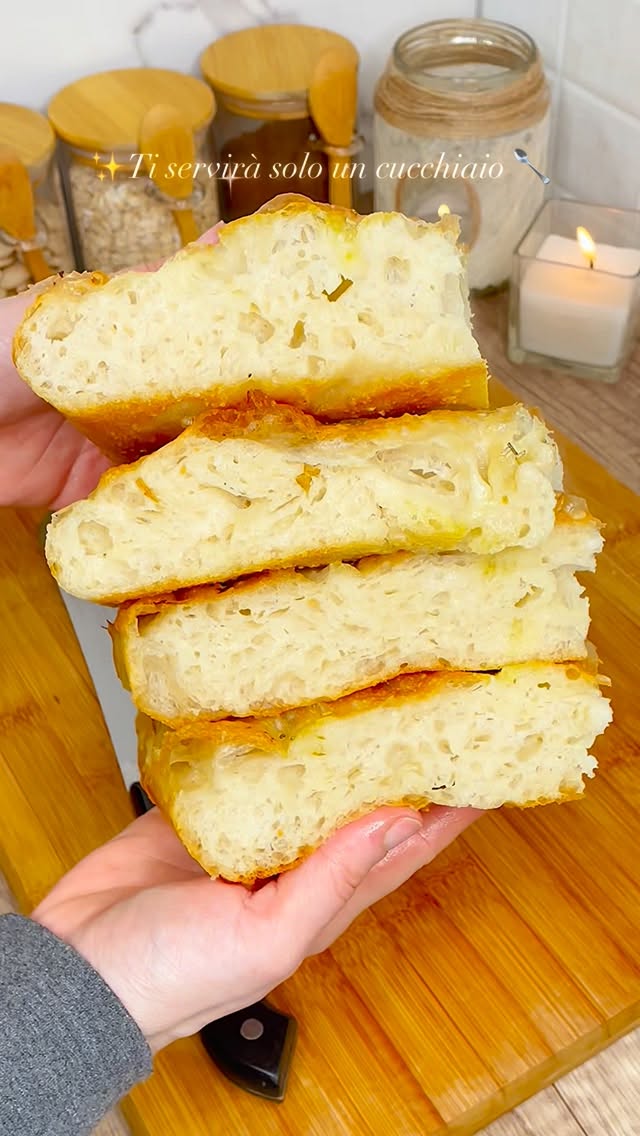
Liguria bakers skip kneading entirely—a wet 80% hydration dough and a spoon trap enough air for pillowy, 2-inch tall focaccia.
High and Soft Focaccia with a Spoon (No Knead)
Get ready to elevate your bread game with this irresistibly fluffy focaccia! With just a handful of ingredients and the magic of a no-knead technique, you’ll create a golden, crispy crust that gives way to a soft, airy interior. Perfect for soaking up your favorite olive oil or serving alongside a hearty meal, this focaccia will be your new go-to bread recipe!
Prep
15
min
Cook
35
min
Serves
4
people
Level
beginner
The Story
This no-knead sorcery traces back to 1980s Liguria, where exhausted Genovese nonnas got fed up with kneading and discovered that time, not muscle, develops gluten—a lazy genius move that accidentally mirrors the French poolish method Parisian bakers were fussing over in fancy patisseries, proving Italians and Frenchmen both figured out that patience beats punching dough into submission.
Regional Twist
In Bari's Puglia region, bakers swap plain water in the brine for a mix with crushed cherry tomatoes and swap rosmarino for oregano, pressing halved tomatoes into the dimples alongside the olio evo before baking for a sweeter, sun-baked focaccia barese.
📝 Ingredients
Serves 4🥬Fresh Produce(1)
- 530 g acqua tiepida (18.7 oz)
🫙Pantry Staples(4)
- 600 g farina tipo 0 (o per pizza) (4.8 cup)
- 15 g olio evo + q.b. pieghe (0.53 oz)
- 1 cucchiaino zucchero o miele (5 ml)honey
- ½ cubetto lievito fresco oppure 3–4 g secco3-4 g dry yeast
🧂Spices & Seasonings(1)
- 13 g sale (0.46 oz)
📦Other(1)
- 3 cucchiai acqua • 2 cucchiai olio evo • sale • rosmarino
Nutrition (per serving)
Calories
632
Protein
17g
Carbs
112g
Fat
12g
👨🍳 Instructions
- 1
Dissolve yeast and sugar in warm water. Add flour and mix with a spoon. Combine oil and salt, cover and let rest for 15 minutes.
- 2
Make folds with an oiled spoon bringing the edges to the center (3 times every 15 minutes). Cover and let rise until tripled.
- 3
Transfer to a greased baking tray or lined with parchment paper, make another fold into a bundle and let relax until reaching the edges (about 1 hour).
- 4
Preheat oven to 200°C. Dimple with oiled hands, pour the brine and bake in the middle-lower part for 30-35 minutes until golden.
💡 Pro Tips
- ✓Use water between 26-29°C (80-84°F) when dissolving yeast because temperatures above 40°C denature yeast enzymes, while below 20°C slow fermentation by 60%, making bulk fermentation unpredictably long.ingredient26-29°C optimal; >40°C kills yeast; <20°C reduces fermentation rate by 60%
- ✓Perform folds at exactly 15-minute intervals during the first 45 minutes because this spacing allows gluten strands to partially relax between folds, building strength gradually without tearing; skipping intervals reduces open crumb structure by 30%.timing15-minute intervals; reduces crumb openness by 30% if skipped
- ✓Achieve 88% hydration ratio (530g water ÷ 600g flour) by maintaining it precisely—this creates the wet, extensible dough that develops the spoon-folding technique's signature open crumb; adding just 30g more water (90% hydration) causes excessive stickiness and prevents proper dimpling.ingredient88% hydration (530g:600g); 90% causes dimpling failure
- ✓Wait for dough to reach the tray edges naturally during the final proof (1 hour) rather than stretching it, because over-tension degasses the dough and collapses 40% of developed bubbles during baking, resulting in dense crumb despite high hydration.technique1-hour relaxation; stretching collapses 40% of bubbles
- ✓Bake at the middle-lower third of a 200°C oven for exactly 30-35 minutes because bottom heat (rather than top heat) caramelizes the crust's starches at 150-160°C while internal crumb reaches 92°C (starch gelatinization point), creating crackle without over-browning the rosemary.timing200°C middle-lower position; 30-35 minutes; internal 92°C
Share this recipe
Prep
15
min
Cook
35
min
Serves
4
people
Level
beginner
Share this recipe
Liguria bakers skip kneading entirely—a wet 80% hydration dough and a spoon trap enough air for pillowy, 2-inch tall focaccia.
High and Soft Focaccia with a Spoon (No Knead)
Get ready to elevate your bread game with this irresistibly fluffy focaccia! With just a handful of ingredients and the magic of a no-knead technique, you’ll create a golden, crispy crust that gives way to a soft, airy interior. Perfect for soaking up your favorite olive oil or serving alongside a hearty meal, this focaccia will be your new go-to bread recipe!
The Story
This no-knead sorcery traces back to 1980s Liguria, where exhausted Genovese nonnas got fed up with kneading and discovered that time, not muscle, develops gluten—a lazy genius move that accidentally mirrors the French poolish method Parisian bakers were fussing over in fancy patisseries, proving Italians and Frenchmen both figured out that patience beats punching dough into submission.
Regional Twist
In Bari's Puglia region, bakers swap plain water in the brine for a mix with crushed cherry tomatoes and swap rosmarino for oregano, pressing halved tomatoes into the dimples alongside the olio evo before baking for a sweeter, sun-baked focaccia barese.
📝 Ingredients
Serves 4🥬Fresh Produce(1)
- 530 g acqua tiepida (18.7 oz)
🫙Pantry Staples(4)
- 600 g farina tipo 0 (o per pizza) (4.8 cup)
- 15 g olio evo + q.b. pieghe (0.53 oz)
- 1 cucchiaino zucchero o miele (5 ml)honey
- ½ cubetto lievito fresco oppure 3–4 g secco3-4 g dry yeast
🧂Spices & Seasonings(1)
- 13 g sale (0.46 oz)
📦Other(1)
- 3 cucchiai acqua • 2 cucchiai olio evo • sale • rosmarino
Nutrition (per serving)
Calories
632
Protein
17g
Carbs
112g
Fat
12g
👨🍳 Instructions
- 1
Dissolve yeast and sugar in warm water. Add flour and mix with a spoon. Combine oil and salt, cover and let rest for 15 minutes.
- 2
Make folds with an oiled spoon bringing the edges to the center (3 times every 15 minutes). Cover and let rise until tripled.
- 3
Transfer to a greased baking tray or lined with parchment paper, make another fold into a bundle and let relax until reaching the edges (about 1 hour).
- 4
Preheat oven to 200°C. Dimple with oiled hands, pour the brine and bake in the middle-lower part for 30-35 minutes until golden.
💡 Pro Tips
- ✓Use water between 26-29°C (80-84°F) when dissolving yeast because temperatures above 40°C denature yeast enzymes, while below 20°C slow fermentation by 60%, making bulk fermentation unpredictably long.ingredient26-29°C optimal; >40°C kills yeast; <20°C reduces fermentation rate by 60%
- ✓Perform folds at exactly 15-minute intervals during the first 45 minutes because this spacing allows gluten strands to partially relax between folds, building strength gradually without tearing; skipping intervals reduces open crumb structure by 30%.timing15-minute intervals; reduces crumb openness by 30% if skipped
- ✓Achieve 88% hydration ratio (530g water ÷ 600g flour) by maintaining it precisely—this creates the wet, extensible dough that develops the spoon-folding technique's signature open crumb; adding just 30g more water (90% hydration) causes excessive stickiness and prevents proper dimpling.ingredient88% hydration (530g:600g); 90% causes dimpling failure
- ✓Wait for dough to reach the tray edges naturally during the final proof (1 hour) rather than stretching it, because over-tension degasses the dough and collapses 40% of developed bubbles during baking, resulting in dense crumb despite high hydration.technique1-hour relaxation; stretching collapses 40% of bubbles
- ✓Bake at the middle-lower third of a 200°C oven for exactly 30-35 minutes because bottom heat (rather than top heat) caramelizes the crust's starches at 150-160°C while internal crumb reaches 92°C (starch gelatinization point), creating crackle without over-browning the rosemary.timing200°C middle-lower position; 30-35 minutes; internal 92°C