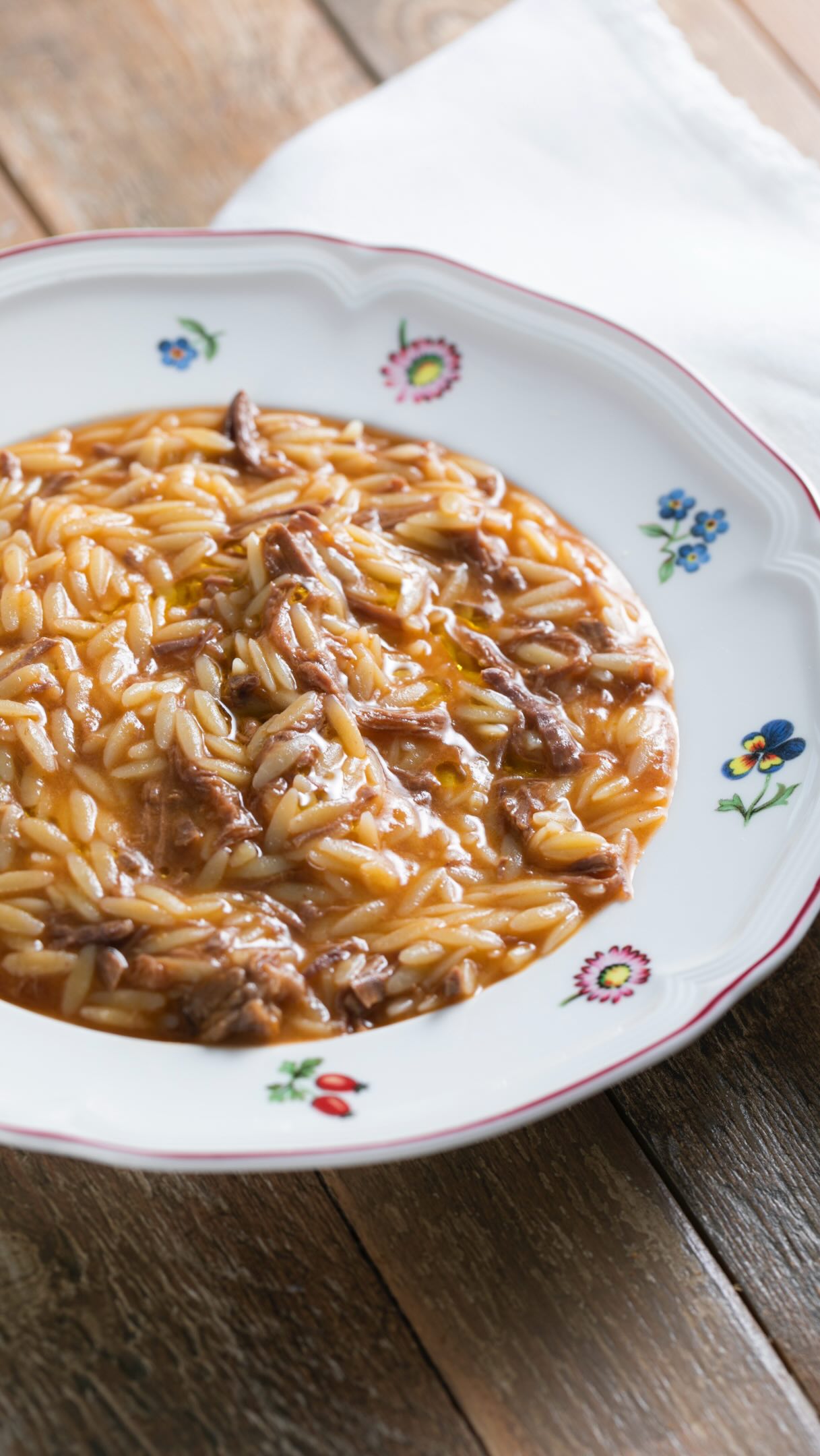
Naples calls this 'Italian penicillin'—tiny star pasta simmers in bone broth, a bedside remedy served to feverish kids since the 1800s.
Grandma's Pastina in Meat Broth
Indulge in a warm bowl of nostalgia with our Grandma's Pastina in Savory Meat Broth! This delightful dish features tiny pasta simmered to perfection in a rich, flavorful broth, infused with tender chunks of beef and aromatic herbs. It's the ultimate comfort food that brings back the coziness of childhood, making every spoonful a heartwarming experience!
Prep
15
min
Cook
120
min
Serves
4
people
Level
intermediate
The Story
This nonna-grade brodo traces back to 19th-century Emilia-Romagna, where peasant kitchens stretched tough muscolo di manzo into gold by simmering it for hours alongside the holy trinity of onion, carrot, and celery—a technique Catherine de' Medici's cooks allegedly carried to France, where it became the backbone of consommé, proving Italians were doing bone broth centuries before wellness influencers discovered it existed.
Regional Twist
In Naples, cooks ditch the risoni for tubettini and stir in a knob of butter alongside the Parmigiano, while some Campania grandmothers swap the celery for a splash of white wine in the broth, giving Grandma's pastina a brighter, slightly sweeter southern backbone entirely.
📝 Ingredients
Serves 4🥬Fresh Produce(3)
- 1 carota 50 gr
- 1 gambo di sedano 50 gr
- 1 cipolla bianca 50 gr
🥩Meat & Seafood(1)
- 400 g di muscolo di manzo a pezzi (0.88 lbs)
🥛Dairy & Eggs(1)
- 4 cucchiai di formaggio grattugiato tipo Parmigiano 30 gr (1.06 oz)
🫙Pantry Staples(2)
- 320 g di pastina tipo risoni o stellina circa (11.3 oz)
- Concentrato di pomodoro 1 cucchiaio 10 gr (0.35 oz)
🧂Spices & Seasonings(2)
- 1 foglia alloro
- Sale, olio qboptional
Nutrition (per serving)
Calories
532
Protein
35g
Carbs
60g
Fat
16g
👨🍳 Instructions
- 1
Put the beef pieces in plenty of cold water and add the onion, carrot, and celery in pieces, the bay leaf, and the tomato paste. Cook for about 2 hours, or until the meat becomes tender (or 1 hour in a pressure cooker from the whistle).
- 2
During cooking, remove the foam that forms on the surface to obtain a clearer, lighter broth. Add salt only in the last half hour to keep the flavor balanced.
- 3
When the meat is tender, remove it from the broth and shred it by hand. Blend the vegetables until creamy. In the broth (if it's too much, remove some), cook the small pasta, then add the meat and the vegetable cream. Stir, adjust the creaminess with more broth if needed, and off the heat, finish with a drizzle of oil and grated Parmesan. Serve immediately.
💡 Pro Tips
- ✓Start beef in cold water rather than hot water to extract maximum collagen (gelatin) into the broth; cold water allows proteins to denature gradually, converting collagen to gelatin at 160-185°F over 2 hours instead of sealing the surface.technique160-185°F conversion range
- ✓Skim foam during the first 30 minutes of cooking when impurities are most active; foam is denatured protein and blood cells that cloud broth clarity, and skimming after this window has diminishing returns.timingFirst 30 minutes
- ✓Add salt only in the final 30 minutes because sodium ions penetrate meat slowly; early salting denatures myosin proteins on the surface, causing them to retain moisture rather than allowing the broth to extract savory compounds.timingLast 30 minutes
- ✓Cook pastina to exactly 1 minute under package recommendation in the broth itself, not separately; residual starch (approximately 8-12% by weight) releases into the hot broth, creating natural creaminess while pasta continues cooking from carryover heat for 1-2 minutes after plating.timing1 minute under package time
- ✓Blend vegetables until they reach 95°C (203°F) internal temperature for maximum starch gelatinization and pectin breakdown, creating a silky emulsion rather than a grainy purée; use an immersion blender directly in the broth to keep emulsion stable.technique95°C internal temperature
Share this recipe
Prep
15
min
Cook
120
min
Serves
4
people
Level
intermediate
Share this recipe
Naples calls this 'Italian penicillin'—tiny star pasta simmers in bone broth, a bedside remedy served to feverish kids since the 1800s.
Grandma's Pastina in Meat Broth
Indulge in a warm bowl of nostalgia with our Grandma's Pastina in Savory Meat Broth! This delightful dish features tiny pasta simmered to perfection in a rich, flavorful broth, infused with tender chunks of beef and aromatic herbs. It's the ultimate comfort food that brings back the coziness of childhood, making every spoonful a heartwarming experience!
The Story
This nonna-grade brodo traces back to 19th-century Emilia-Romagna, where peasant kitchens stretched tough muscolo di manzo into gold by simmering it for hours alongside the holy trinity of onion, carrot, and celery—a technique Catherine de' Medici's cooks allegedly carried to France, where it became the backbone of consommé, proving Italians were doing bone broth centuries before wellness influencers discovered it existed.
Regional Twist
In Naples, cooks ditch the risoni for tubettini and stir in a knob of butter alongside the Parmigiano, while some Campania grandmothers swap the celery for a splash of white wine in the broth, giving Grandma's pastina a brighter, slightly sweeter southern backbone entirely.
📝 Ingredients
Serves 4🥬Fresh Produce(3)
- 1 carota 50 gr
- 1 gambo di sedano 50 gr
- 1 cipolla bianca 50 gr
🥩Meat & Seafood(1)
- 400 g di muscolo di manzo a pezzi (0.88 lbs)
🥛Dairy & Eggs(1)
- 4 cucchiai di formaggio grattugiato tipo Parmigiano 30 gr (1.06 oz)
🫙Pantry Staples(2)
- 320 g di pastina tipo risoni o stellina circa (11.3 oz)
- Concentrato di pomodoro 1 cucchiaio 10 gr (0.35 oz)
🧂Spices & Seasonings(2)
- 1 foglia alloro
- Sale, olio qboptional
Nutrition (per serving)
Calories
532
Protein
35g
Carbs
60g
Fat
16g
👨🍳 Instructions
- 1
Put the beef pieces in plenty of cold water and add the onion, carrot, and celery in pieces, the bay leaf, and the tomato paste. Cook for about 2 hours, or until the meat becomes tender (or 1 hour in a pressure cooker from the whistle).
- 2
During cooking, remove the foam that forms on the surface to obtain a clearer, lighter broth. Add salt only in the last half hour to keep the flavor balanced.
- 3
When the meat is tender, remove it from the broth and shred it by hand. Blend the vegetables until creamy. In the broth (if it's too much, remove some), cook the small pasta, then add the meat and the vegetable cream. Stir, adjust the creaminess with more broth if needed, and off the heat, finish with a drizzle of oil and grated Parmesan. Serve immediately.
💡 Pro Tips
- ✓Start beef in cold water rather than hot water to extract maximum collagen (gelatin) into the broth; cold water allows proteins to denature gradually, converting collagen to gelatin at 160-185°F over 2 hours instead of sealing the surface.technique160-185°F conversion range
- ✓Skim foam during the first 30 minutes of cooking when impurities are most active; foam is denatured protein and blood cells that cloud broth clarity, and skimming after this window has diminishing returns.timingFirst 30 minutes
- ✓Add salt only in the final 30 minutes because sodium ions penetrate meat slowly; early salting denatures myosin proteins on the surface, causing them to retain moisture rather than allowing the broth to extract savory compounds.timingLast 30 minutes
- ✓Cook pastina to exactly 1 minute under package recommendation in the broth itself, not separately; residual starch (approximately 8-12% by weight) releases into the hot broth, creating natural creaminess while pasta continues cooking from carryover heat for 1-2 minutes after plating.timing1 minute under package time
- ✓Blend vegetables until they reach 95°C (203°F) internal temperature for maximum starch gelatinization and pectin breakdown, creating a silky emulsion rather than a grainy purée; use an immersion blender directly in the broth to keep emulsion stable.technique95°C internal temperature