Lebanese torshi gets its shocking magenta hue from red cabbage meeting vinegar—sumac adds tangy citrus notes vinegar alone can't replicate.
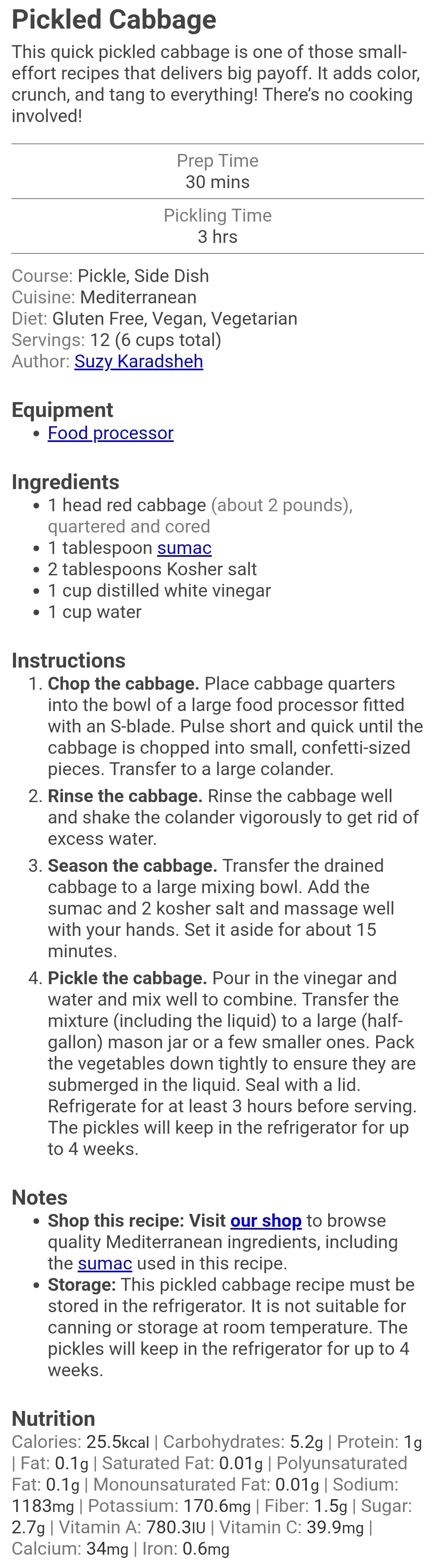
Pickled Cabbage
This quick pickled cabbage adds color, crunch, and tang to everything with no cooking involved.
Prep
30
min
Cook
0
min
Serves
12
people
Level
beginner
The Story
This crimson stuff is basically Lebanon shaking hands with Turkey, born from centuries of Levantine street vendors slapping sumac-dusted cabbage onto shawarma because plain cabbage is about as exciting as a caravan holiday. The sumac—a Middle Eastern staple since Ottoman times—turns boring brassica into something that fights back against fatty lamb, which is precisely why every self-respecting Beirut sandwich shop refuses to serve shawarma without it.
Regional Twist
In Lebanon's Beqaa Valley, cooks ditch distilled vinegar entirely, swapping it for pomegranate molasses alongside the sumac, giving the cabbage a sweeter, fruitier tang that clings to grilled meats instead of just sitting there looking pretty.
📝 Ingredients
Serves 12🥬Fresh Produce(2)
- 1 head red cabbage (about 2 pounds), quartered and cored
- 1 cup water
🧂Spices & Seasonings(2)
- 2 tablespoons Kosher salt
- 1 tablespoon sumac
🍯Sauces & Condiments(1)
- 1 cup distilled white vinegar
Nutrition (per serving)
Calories
22
Protein
1g
Carbs
5g
Fat
0g
👨🍳 Instructions
- 1
Chop the cabbage. Place cabbage quarters into the bowl of a large food processor fitted with an S-blade. Pulse until chopped into small, confetti-sized pieces. Transfer to a large colander.
- 2
Rinse the cabbage. Rinse well and shake the colander vigorously to remove excess water.
- 3
Season the cabbage. Transfer to a large mixing bowl. Add the sumac and 2 tablespoons of kosher salt, massage well, and set aside for about 15 minutes.
- 4
Pickle the cabbage. Pour in the vinegar and water, mix well, and transfer to a large mason jar. Pack tightly to ensure submersion in liquid. Seal with a lid and refrigerate for at least 3 hours before serving.
💡 Pro Tips
- ✓Massage the cabbage with salt for exactly 15 minutes to break down cell walls and allow osmosis to draw out 15-20% of the cabbage's water content, which concentrates flavor and creates space for pickling liquid absorption.timing15 minutes|15-20% water extraction
- ✓Use a 1:1 vinegar-to-water ratio (50% acidity) rather than straight vinegar because the diluted acid penetrates cabbage cell membranes at optimal speed while preventing over-softening from excessive acid denaturation of pectin.ingredient1:1 ratio|50% acidity
- ✓Pack the mason jar so cabbage sits 1 inch below the pickling liquid surface—use a fermentation weight or small bowl to keep it submerged, since exposed cabbage oxidizes and develops off-flavors within 24 hours.technique1 inch submersion depth
- ✓Refrigerate immediately after sealing rather than fermenting at room temperature; cold storage slows lactic acid bacteria growth and preserves the bright red anthocyanin pigments that fade 30-40% faster above 50°F.timingBelow 50°F|30-40% pigment loss prevention
- ✓Add sumac after the 15-minute salt massage, not before, because its tannins will bind to released cell fluids and mute the acid's penetration if added prematurely.technique
Share this recipe
Prep
30
min
Cook
0
min
Serves
12
people
Level
beginner
Share this recipe
Lebanese torshi gets its shocking magenta hue from red cabbage meeting vinegar—sumac adds tangy citrus notes vinegar alone can't replicate.
Pickled Cabbage
This quick pickled cabbage adds color, crunch, and tang to everything with no cooking involved.
The Story
This crimson stuff is basically Lebanon shaking hands with Turkey, born from centuries of Levantine street vendors slapping sumac-dusted cabbage onto shawarma because plain cabbage is about as exciting as a caravan holiday. The sumac—a Middle Eastern staple since Ottoman times—turns boring brassica into something that fights back against fatty lamb, which is precisely why every self-respecting Beirut sandwich shop refuses to serve shawarma without it.
Regional Twist
In Lebanon's Beqaa Valley, cooks ditch distilled vinegar entirely, swapping it for pomegranate molasses alongside the sumac, giving the cabbage a sweeter, fruitier tang that clings to grilled meats instead of just sitting there looking pretty.
📝 Ingredients
Serves 12🥬Fresh Produce(2)
- 1 head red cabbage (about 2 pounds), quartered and cored
- 1 cup water
🧂Spices & Seasonings(2)
- 2 tablespoons Kosher salt
- 1 tablespoon sumac
🍯Sauces & Condiments(1)
- 1 cup distilled white vinegar
Nutrition (per serving)
Calories
22
Protein
1g
Carbs
5g
Fat
0g
👨🍳 Instructions
- 1
Chop the cabbage. Place cabbage quarters into the bowl of a large food processor fitted with an S-blade. Pulse until chopped into small, confetti-sized pieces. Transfer to a large colander.
- 2
Rinse the cabbage. Rinse well and shake the colander vigorously to remove excess water.
- 3
Season the cabbage. Transfer to a large mixing bowl. Add the sumac and 2 tablespoons of kosher salt, massage well, and set aside for about 15 minutes.
- 4
Pickle the cabbage. Pour in the vinegar and water, mix well, and transfer to a large mason jar. Pack tightly to ensure submersion in liquid. Seal with a lid and refrigerate for at least 3 hours before serving.
💡 Pro Tips
- ✓Massage the cabbage with salt for exactly 15 minutes to break down cell walls and allow osmosis to draw out 15-20% of the cabbage's water content, which concentrates flavor and creates space for pickling liquid absorption.timing15 minutes|15-20% water extraction
- ✓Use a 1:1 vinegar-to-water ratio (50% acidity) rather than straight vinegar because the diluted acid penetrates cabbage cell membranes at optimal speed while preventing over-softening from excessive acid denaturation of pectin.ingredient1:1 ratio|50% acidity
- ✓Pack the mason jar so cabbage sits 1 inch below the pickling liquid surface—use a fermentation weight or small bowl to keep it submerged, since exposed cabbage oxidizes and develops off-flavors within 24 hours.technique1 inch submersion depth
- ✓Refrigerate immediately after sealing rather than fermenting at room temperature; cold storage slows lactic acid bacteria growth and preserves the bright red anthocyanin pigments that fade 30-40% faster above 50°F.timingBelow 50°F|30-40% pigment loss prevention
- ✓Add sumac after the 15-minute salt massage, not before, because its tannins will bind to released cell fluids and mute the acid's penetration if added prematurely.technique