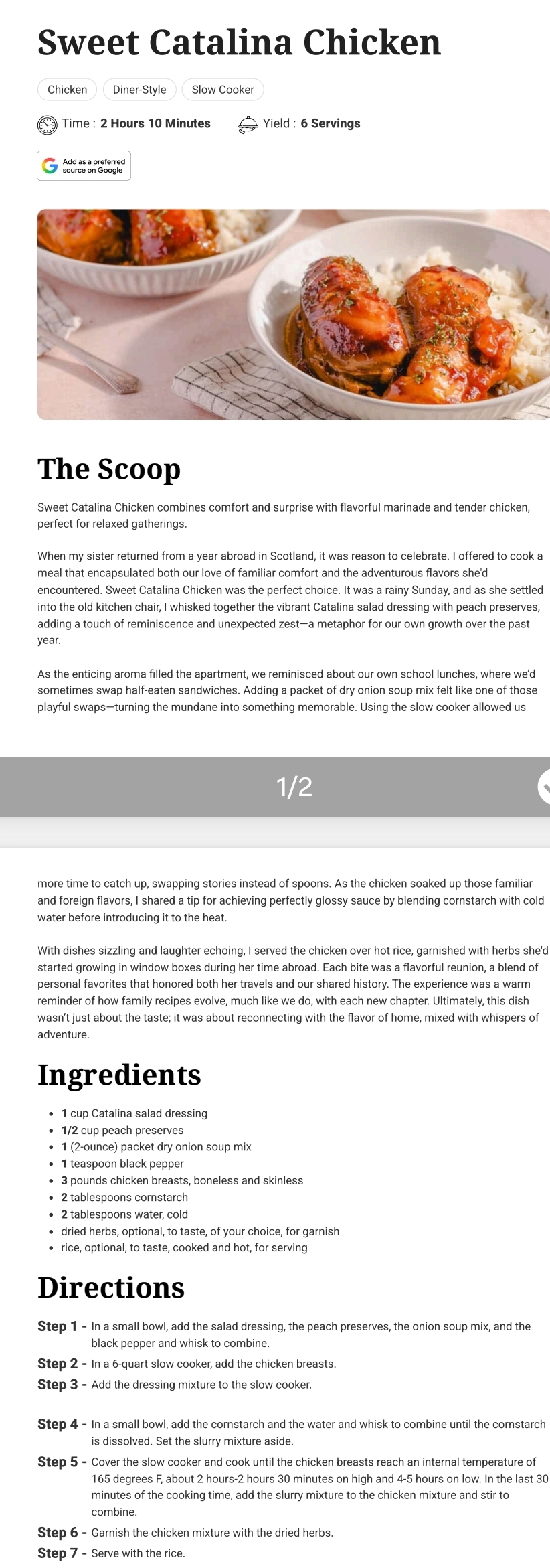
This 1950s pantry-shelf recipe relies on dry onion soup mix for depth—no sautéing required, just three jarred ingredients and an oven.
Sweet Catalina Chicken
Sweet Catalina Chicken combines comfort and surprise with flavorful marinade and tender chicken, perfect for relaxed gatherings.
Prep
10
min
Cook
120
min
Serves
6
people
Level
beginner
The Story
This frankenstein dish is pure 1950s American pantry archaeology, born when Midwest housewives discovered Lipton's dehydrated onion soup mix could fake French onion soup, then some genius in Georgia married it to French-named Catalina dressing—which has zero connection to the actual Catalina Island—and tossed in peach preserves, creating a Southern-suburban fusion dish with a passport full of lies.
Regional Twist
Down in Savannah, Georgia, cooks swap the peach preserves for actual Georgia peach butter and add a splash of bourbon to the dressing mixture, turning this slow cooker staple into something that tastes properly Southern instead of vaguely confused about its origins.
📝 Ingredients
Serves 6🥬Fresh Produce(4)
- dried herbs, optional, to taste, of your choice, for garnish
- 1 (2-ounce) packet dry onion soup mix
- 1/2 cup peach preserves
- 2 tablespoons water, cold
🥩Meat & Seafood(1)
- 3 pounds chicken breasts, boneless and skinless
🫙Pantry Staples(2)
- 2 tablespoons cornstarch
- rice, optional, to taste, cooked and hot, for serving
🧂Spices & Seasonings(1)
- 1 teaspoon black pepper
📦Other(1)
- 1 cup Catalina salad dressing
Nutrition (per serving)
Calories
568
Protein
69g
Carbs
37g
Fat
15g
👨🍳 Instructions
- 1
In a small bowl, add the salad dressing, the peach preserves, the onion soup mix, and the black pepper and whisk to combine.
- 2
In a 6-quart slow cooker, add the chicken breasts.
- 3
Add the dressing mixture to the slow cooker.
- 4
In a small bowl, add the cornstarch and the water and whisk to combine until the cornstarch is dissolved. Set the slurry mixture aside.
- 5
Cover the slow cooker and cook until the chicken breasts reach an internal temperature of 165 degrees F, about 2 hours-2 hours 30 minutes on high and 4-5 hours on low. In the last 30 minutes of the cooking time, add the slurry mixture to the chicken mixture and stir to combine.
- 6
Garnish the chicken mixture with the dried herbs.
- 7
Serve with the rice.
💡 Pro Tips
- ✓Add the cornstarch slurry in the final 30 minutes rather than at the start because the acidic Catalina dressing (pH ~3.2) and peach preserves break down cornstarch's thickening power if exposed to prolonged heat and acid, reducing viscosity by up to 60%.timing30 minutes before serving
- ✓Dissolve cornstarch completely in cold water (not hot) before adding to the slow cooker; cold liquid prevents gelatinization and clumping, while the sauce's residual heat (180-190°F) activates the starch molecules uniformly across the liquid.techniqueCold water dissolution, final temp 180-190°F
- ✓Use a 2:1 ratio of Catalina dressing to peach preserves (1 cup to 0.5 cup) because the vinegar in Catalina (typically 4-5% acidity) needs the pectin and sugar from preserves to achieve proper sauce body; excess preserves create overly thick, gel-like sauce that masks chicken flavor.ingredient2:1 ratio (dressing:preserves)
- ✓Pull chicken at exactly 165°F internal temperature using a meat thermometer at the thickest part; cooking beyond this in the slow cooker's moist environment causes myosin proteins to contract excessively and expel moisture, resulting in dry meat even though liquid surrounds it.technique165°F internal temperature
- ✓Stir the slurry mixture into the sauce immediately after adding it; the onion soup mix (which contains starch) can create localized thick spots if the cornstarch slurry pools in one area rather than dispersing uniformly throughout the 1-cup liquid base.techniqueImmediate stirring after addition
Share this recipe
Prep
10
min
Cook
120
min
Serves
6
people
Level
beginner
Share this recipe
This 1950s pantry-shelf recipe relies on dry onion soup mix for depth—no sautéing required, just three jarred ingredients and an oven.
Sweet Catalina Chicken
Sweet Catalina Chicken combines comfort and surprise with flavorful marinade and tender chicken, perfect for relaxed gatherings.
The Story
This frankenstein dish is pure 1950s American pantry archaeology, born when Midwest housewives discovered Lipton's dehydrated onion soup mix could fake French onion soup, then some genius in Georgia married it to French-named Catalina dressing—which has zero connection to the actual Catalina Island—and tossed in peach preserves, creating a Southern-suburban fusion dish with a passport full of lies.
Regional Twist
Down in Savannah, Georgia, cooks swap the peach preserves for actual Georgia peach butter and add a splash of bourbon to the dressing mixture, turning this slow cooker staple into something that tastes properly Southern instead of vaguely confused about its origins.
📝 Ingredients
Serves 6🥬Fresh Produce(4)
- dried herbs, optional, to taste, of your choice, for garnish
- 1 (2-ounce) packet dry onion soup mix
- 1/2 cup peach preserves
- 2 tablespoons water, cold
🥩Meat & Seafood(1)
- 3 pounds chicken breasts, boneless and skinless
🫙Pantry Staples(2)
- 2 tablespoons cornstarch
- rice, optional, to taste, cooked and hot, for serving
🧂Spices & Seasonings(1)
- 1 teaspoon black pepper
📦Other(1)
- 1 cup Catalina salad dressing
Nutrition (per serving)
Calories
568
Protein
69g
Carbs
37g
Fat
15g
👨🍳 Instructions
- 1
In a small bowl, add the salad dressing, the peach preserves, the onion soup mix, and the black pepper and whisk to combine.
- 2
In a 6-quart slow cooker, add the chicken breasts.
- 3
Add the dressing mixture to the slow cooker.
- 4
In a small bowl, add the cornstarch and the water and whisk to combine until the cornstarch is dissolved. Set the slurry mixture aside.
- 5
Cover the slow cooker and cook until the chicken breasts reach an internal temperature of 165 degrees F, about 2 hours-2 hours 30 minutes on high and 4-5 hours on low. In the last 30 minutes of the cooking time, add the slurry mixture to the chicken mixture and stir to combine.
- 6
Garnish the chicken mixture with the dried herbs.
- 7
Serve with the rice.
💡 Pro Tips
- ✓Add the cornstarch slurry in the final 30 minutes rather than at the start because the acidic Catalina dressing (pH ~3.2) and peach preserves break down cornstarch's thickening power if exposed to prolonged heat and acid, reducing viscosity by up to 60%.timing30 minutes before serving
- ✓Dissolve cornstarch completely in cold water (not hot) before adding to the slow cooker; cold liquid prevents gelatinization and clumping, while the sauce's residual heat (180-190°F) activates the starch molecules uniformly across the liquid.techniqueCold water dissolution, final temp 180-190°F
- ✓Use a 2:1 ratio of Catalina dressing to peach preserves (1 cup to 0.5 cup) because the vinegar in Catalina (typically 4-5% acidity) needs the pectin and sugar from preserves to achieve proper sauce body; excess preserves create overly thick, gel-like sauce that masks chicken flavor.ingredient2:1 ratio (dressing:preserves)
- ✓Pull chicken at exactly 165°F internal temperature using a meat thermometer at the thickest part; cooking beyond this in the slow cooker's moist environment causes myosin proteins to contract excessively and expel moisture, resulting in dry meat even though liquid surrounds it.technique165°F internal temperature
- ✓Stir the slurry mixture into the sauce immediately after adding it; the onion soup mix (which contains starch) can create localized thick spots if the cornstarch slurry pools in one area rather than dispersing uniformly throughout the 1-cup liquid base.techniqueImmediate stirring after addition