Bulgarian scientist Stamen Grigorov discovered Lactobacillus bulgaricus in 1905—the exact bacteria strain that turns warm milk into tangy yogurt overnight.
Homemade Yogurt
A simple method to make regular or Greek yogurt at home using whole milk and yogurt starter.
Prep
0
min
Cook
0
min
Serves
4
people
Level
intermediate
The Story
Culturing milk with a reserved spoonful of the last batch traces back to Ottoman-era Bulgaria, where peasants discovered Lactobacillus bulgaricus thrived in clay pots wrapped in wool blankets—centuries later, Americans are doing the exact same thing with a Tupperware and a beach towel, proving that proper fermentation science doesn't care about your postcode or your fancy electric yogurt maker.
Regional Twist
In Bulgaria's Rhodope Mountains, locals skip the vanilla starter entirely, preferring a wild sheep's milk culture, then strain the whole milk yogurt through cloth for days longer than this recipe suggests, producing something closer to a spreadable cheese than anything you'd recognize from a supermarket tub.
📝 Ingredients
🥛Dairy & Eggs(3)
- 1 single serve plain vanilla yogurt
- a gallon of whole milk
- 1/2c yogurt reserved from previous batch
Nutrition (per serving)
Calories
164
Protein
9g
Carbs
13g
Fat
8g
👨🍳 Instructions
- 1
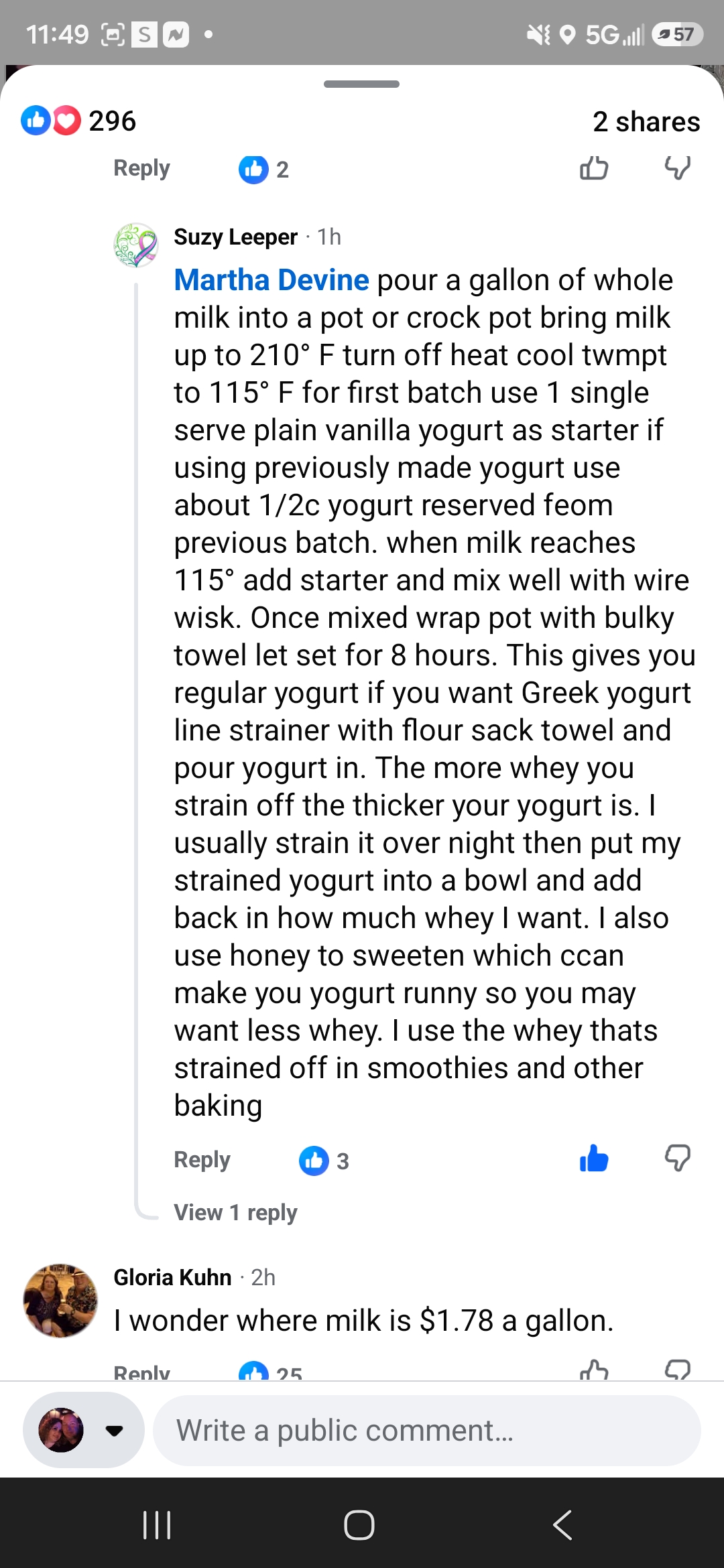
Pour a gallon of whole milk into a pot or crock pot.
- 2
Bring milk up to 210°F, then turn off heat and cool to 115°F.
- 3
For the first batch, use 1 single serve plain vanilla yogurt as a starter. If using previously made yogurt, use about 1/2 cup reserved from the previous batch.
- 4
When milk reaches 115°F, add starter and mix well with a wire whisk.
- 5
Wrap pot with a bulky towel and let set for 8 hours.
- 6
For Greek yogurt, line a strainer with a flour sack towel and pour yogurt in to strain.
- 7
Strain overnight for thicker yogurt. Add back whey as desired.
- 8
Sweeten with honey if desired, but note it may make yogurt runny.
💡 Pro Tips
- ✓Heat milk to 210°F and hold for 1 minute before cooling to denature whey proteins and eliminate competing bacteria, increasing yogurt viscosity by 15-20% and improving set consistency.timing210°F for 1 minute
- ✓Cool milk to exactly 115°F before adding starter culture because Lactobacillus bulgaricus and Streptococcus thermophilus have peak metabolic activity at this temperature; below 110°F fermentation slows 40%, above 120°F starter cells die.technique115°F optimal range
- ✓Use a 1:32 ratio of starter to milk (1/2 cup starter per gallon) because this concentration of live cultures (typically 10^8-10^9 CFU/mL) provides sufficient lactic acid bacteria to ferment lactose and reach pH 4.6 in exactly 8 hours.ingredient1:32 ratio (1/2 cup per gallon)
- ✓Maintain incubation temperature between 110-115°F for the full 8 hours using a towel wrap or cooler because temperature drops of just 5°F extend fermentation by 2-3 hours and result in grainy, separated curds.technique110-115°F for 8 hours
- ✓Strain Greek yogurt for 10-12 hours (not overnight) to achieve 2:1 whey-to-curd ratio; longer straining removes excess moisture but also removes lactose that lowers the freezing point, making yogurt icy when frozen.timing10-12 hours for optimal 2:1 ratio
Share this recipe
Prep
0
min
Cook
0
min
Serves
4
people
Level
intermediate
Share this recipe
Bulgarian scientist Stamen Grigorov discovered Lactobacillus bulgaricus in 1905—the exact bacteria strain that turns warm milk into tangy yogurt overnight.
Homemade Yogurt
A simple method to make regular or Greek yogurt at home using whole milk and yogurt starter.
The Story
Culturing milk with a reserved spoonful of the last batch traces back to Ottoman-era Bulgaria, where peasants discovered Lactobacillus bulgaricus thrived in clay pots wrapped in wool blankets—centuries later, Americans are doing the exact same thing with a Tupperware and a beach towel, proving that proper fermentation science doesn't care about your postcode or your fancy electric yogurt maker.
Regional Twist
In Bulgaria's Rhodope Mountains, locals skip the vanilla starter entirely, preferring a wild sheep's milk culture, then strain the whole milk yogurt through cloth for days longer than this recipe suggests, producing something closer to a spreadable cheese than anything you'd recognize from a supermarket tub.
📝 Ingredients
🥛Dairy & Eggs(3)
- 1 single serve plain vanilla yogurt
- a gallon of whole milk
- 1/2c yogurt reserved from previous batch
Nutrition (per serving)
Calories
164
Protein
9g
Carbs
13g
Fat
8g
👨🍳 Instructions
- 1
Pour a gallon of whole milk into a pot or crock pot.
- 2
Bring milk up to 210°F, then turn off heat and cool to 115°F.
- 3
For the first batch, use 1 single serve plain vanilla yogurt as a starter. If using previously made yogurt, use about 1/2 cup reserved from the previous batch.
- 4
When milk reaches 115°F, add starter and mix well with a wire whisk.
- 5
Wrap pot with a bulky towel and let set for 8 hours.
- 6
For Greek yogurt, line a strainer with a flour sack towel and pour yogurt in to strain.
- 7
Strain overnight for thicker yogurt. Add back whey as desired.
- 8
Sweeten with honey if desired, but note it may make yogurt runny.
💡 Pro Tips
- ✓Heat milk to 210°F and hold for 1 minute before cooling to denature whey proteins and eliminate competing bacteria, increasing yogurt viscosity by 15-20% and improving set consistency.timing210°F for 1 minute
- ✓Cool milk to exactly 115°F before adding starter culture because Lactobacillus bulgaricus and Streptococcus thermophilus have peak metabolic activity at this temperature; below 110°F fermentation slows 40%, above 120°F starter cells die.technique115°F optimal range
- ✓Use a 1:32 ratio of starter to milk (1/2 cup starter per gallon) because this concentration of live cultures (typically 10^8-10^9 CFU/mL) provides sufficient lactic acid bacteria to ferment lactose and reach pH 4.6 in exactly 8 hours.ingredient1:32 ratio (1/2 cup per gallon)
- ✓Maintain incubation temperature between 110-115°F for the full 8 hours using a towel wrap or cooler because temperature drops of just 5°F extend fermentation by 2-3 hours and result in grainy, separated curds.technique110-115°F for 8 hours
- ✓Strain Greek yogurt for 10-12 hours (not overnight) to achieve 2:1 whey-to-curd ratio; longer straining removes excess moisture but also removes lactose that lowers the freezing point, making yogurt icy when frozen.timing10-12 hours for optimal 2:1 ratio