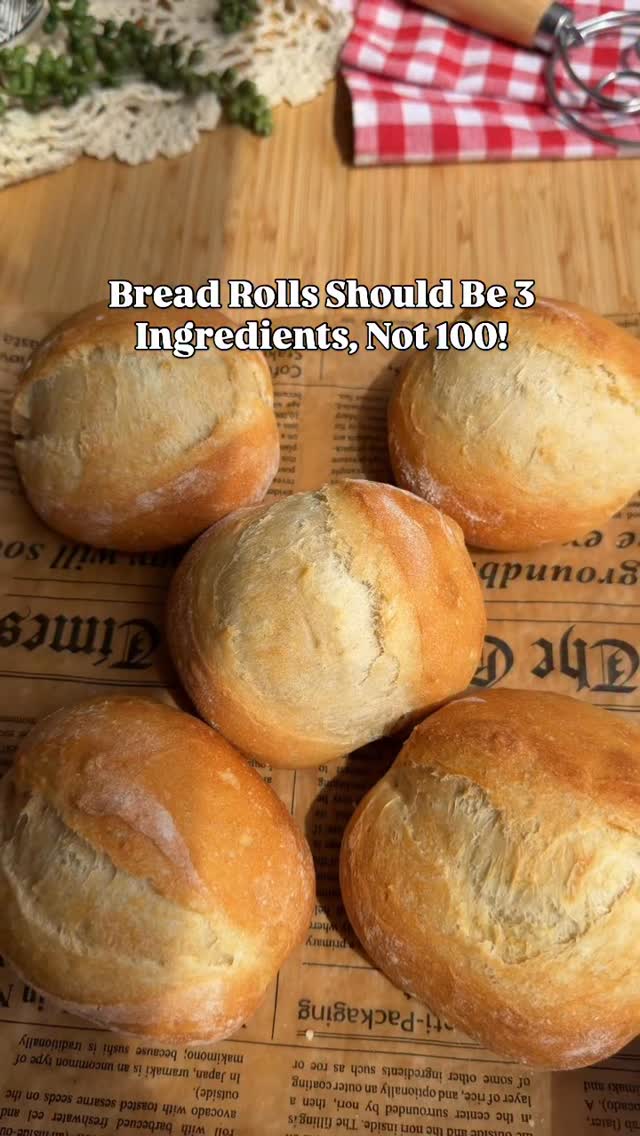
Just 4 ingredients, yet yeast converts flour's starch into CO2 gas pockets—the same fermentation science bakers relied on 5,000 years ago.
Bread Rolls
Whip up a batch of irresistible homemade bread rolls that are sure to steal the spotlight at any meal! With just flour, yeast, and a touch of love, you’ll be kneading your way to soft, fluffy perfection. Perfect for soaking up sauces or enjoying warm with butter, these rolls are a must-try for any bread lover!
Prep
15
min
Cook
25
min
Serves
5
people
Level
beginner
The Story
This four-ingredient miracle traces back to Poilâne's Paris bakery in the 1930s, where Pierre Poilâne stripped bread back to its medieval French monastery roots—just flour, water, salt, and wild yeast—proving Germans and Austrians didn't invent minimalist baking with their roggenbrot, the French just did it with more attitude and a better beret while everyone else was adding sugar like cowards.
Regional Twist
In Naples, bakers swap standard flour for a blend including semolina, giving these rolls a denser, golden crumb, then finish with a olive oil brush instead of water before baking—because Neapolitans think plain water on crust is for people who hate flavor.
📝 Ingredients
Serves 5🥬Fresh Produce(1)
- 250g water (1 cup + 5 tbsp) (240 ml)
🫙Pantry Staples(2)
- 365 g flour (3 cups) (375 g)
- 1 tsp yeast (5 ml)
🧂Spices & Seasonings(1)
- 1 tsp salt (5 ml)
Nutrition (per serving)
Calories
267
Protein
8g
Carbs
55g
Fat
1g
👨🍳 Instructions
- 1
Mix yeast and water. Add flour and salt, mix well. Do multiple coil folds (no waiting in between). Cover and rest for 1½ hour.
- 2
On a floured surface, divide dough into 5. Shape each into a small ball and create surface tension by turning it in your hands. Dust with flour and rest for 10 minutes.
- 3
Score each from the side, then lightly brush with water.
- 4
Bake at 480°F (250°C) with steam for 10 minutes, then 385°F (195°C) for 15 minutes until golden.
💡 Pro Tips
- ✓Hydrate your dough to 68.5% (250g water to 365g flour) because this ratio creates enough free water for gluten development without making the dough too sticky to fold during the coil-fold sequence.ingredient68.5% hydration ratio
- ✓Perform coil folds immediately back-to-back during the first 15-20 minutes without rest periods to build gluten strength through mechanical tension before fermentation begins, then allow the full 90-minute bulk rise to develop flavor and structure simultaneously.technique15-20 minutes continuous folding, then 90-minute bulk fermentation
- ✓Create surface tension by rotating each shaped roll 8-10 times in cupped hands to tighten the exterior skin, which traps steam during the 10-minute high-temperature phase and produces a crispy, crackling crust through the Maillard reaction.technique8-10 rotations per roll
- ✓Steam-bake at 480°F for exactly 10 minutes (not longer) because steam gelatinizes surface starches, allowing maximum oven spring; then reduce to 385°F for 15 minutes to set the crust structure without over-browning, as carryover heat continues cooking the interior.timing10 minutes at 480°F with steam, then 15 minutes at 385°F
- ✓Use 1 teaspoon (5g) instant yeast for 615g total dough weight because this 0.8% inoculation rate provides slow, controlled fermentation over 90 minutes, developing complex flavors through organic acid production without over-proofing the bulk dough.ingredient0.8% yeast ratio (5g per 615g dough)
Share this recipe
Prep
15
min
Cook
25
min
Serves
5
people
Level
beginner
Share this recipe
Just 4 ingredients, yet yeast converts flour's starch into CO2 gas pockets—the same fermentation science bakers relied on 5,000 years ago.
Bread Rolls
Whip up a batch of irresistible homemade bread rolls that are sure to steal the spotlight at any meal! With just flour, yeast, and a touch of love, you’ll be kneading your way to soft, fluffy perfection. Perfect for soaking up sauces or enjoying warm with butter, these rolls are a must-try for any bread lover!
The Story
This four-ingredient miracle traces back to Poilâne's Paris bakery in the 1930s, where Pierre Poilâne stripped bread back to its medieval French monastery roots—just flour, water, salt, and wild yeast—proving Germans and Austrians didn't invent minimalist baking with their roggenbrot, the French just did it with more attitude and a better beret while everyone else was adding sugar like cowards.
Regional Twist
In Naples, bakers swap standard flour for a blend including semolina, giving these rolls a denser, golden crumb, then finish with a olive oil brush instead of water before baking—because Neapolitans think plain water on crust is for people who hate flavor.
📝 Ingredients
Serves 5🥬Fresh Produce(1)
- 250g water (1 cup + 5 tbsp) (240 ml)
🫙Pantry Staples(2)
- 365 g flour (3 cups) (375 g)
- 1 tsp yeast (5 ml)
🧂Spices & Seasonings(1)
- 1 tsp salt (5 ml)
Nutrition (per serving)
Calories
267
Protein
8g
Carbs
55g
Fat
1g
👨🍳 Instructions
- 1
Mix yeast and water. Add flour and salt, mix well. Do multiple coil folds (no waiting in between). Cover and rest for 1½ hour.
- 2
On a floured surface, divide dough into 5. Shape each into a small ball and create surface tension by turning it in your hands. Dust with flour and rest for 10 minutes.
- 3
Score each from the side, then lightly brush with water.
- 4
Bake at 480°F (250°C) with steam for 10 minutes, then 385°F (195°C) for 15 minutes until golden.
💡 Pro Tips
- ✓Hydrate your dough to 68.5% (250g water to 365g flour) because this ratio creates enough free water for gluten development without making the dough too sticky to fold during the coil-fold sequence.ingredient68.5% hydration ratio
- ✓Perform coil folds immediately back-to-back during the first 15-20 minutes without rest periods to build gluten strength through mechanical tension before fermentation begins, then allow the full 90-minute bulk rise to develop flavor and structure simultaneously.technique15-20 minutes continuous folding, then 90-minute bulk fermentation
- ✓Create surface tension by rotating each shaped roll 8-10 times in cupped hands to tighten the exterior skin, which traps steam during the 10-minute high-temperature phase and produces a crispy, crackling crust through the Maillard reaction.technique8-10 rotations per roll
- ✓Steam-bake at 480°F for exactly 10 minutes (not longer) because steam gelatinizes surface starches, allowing maximum oven spring; then reduce to 385°F for 15 minutes to set the crust structure without over-browning, as carryover heat continues cooking the interior.timing10 minutes at 480°F with steam, then 15 minutes at 385°F
- ✓Use 1 teaspoon (5g) instant yeast for 615g total dough weight because this 0.8% inoculation rate provides slow, controlled fermentation over 90 minutes, developing complex flavors through organic acid production without over-proofing the bulk dough.ingredient0.8% yeast ratio (5g per 615g dough)